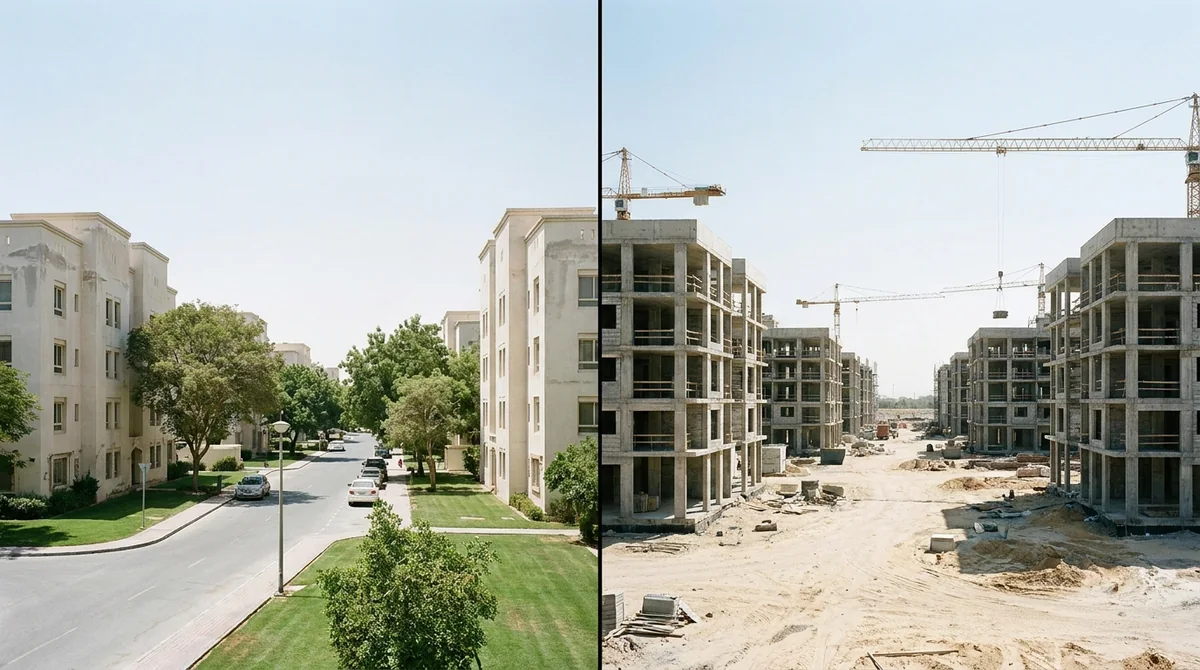
The best test of a developer in Egypt costs nothing and takes an hour: stand inside a phase they delivered five years ago. If you live abroad you cannot run it. Here is what replaces it.
You cannot check an Egyptian developer’s track record from a brochure, and buying from outside Egypt you cannot check it with your feet either. Most of it still works on paper. The rest comes down to one person standing somewhere on your behalf, knowing exactly what to look at.
What that hour would have told you
In a delivered phase you look at the lifts after five years of use, the landscaping at the end of summer, the state of the facades, and how many windows are lit at night. Then you ask the first resident you meet two questions. When did you take handover. Was it on time.
Nothing in a sales lounge competes with that, and it separates a developer with inhabited phases you can inspect from one selling a promise with no precedent. From Cairo you would go on a Friday. From Dubai or Toronto you buy that hour another way: send someone, and make the paperwork carry weight a local buyer never needs it to.
We work across more than 200 developers, and assessing them comes before we put any project in front of a client. Send the developer and project you are considering on WhatsApp and we will come back with what we can document about their delivery record.
How to check an Egyptian developer’s track record when you cannot fly out
Seven checks. Four are documents, and distance costs you nothing on those.
1. Ask for the delivered list, not the announced list
The gap between those two lists is the whole story. Ten announced projects and one delivered project is a different business from three projects, all delivered and lived in.
For every delivered project ask for three things: the year the first contracts were signed, the year handover actually happened, and how many units were handed over. The distance between the first two is the record.
Ask by email, then read what comes back for shape rather than for the total. Are the gaps consistent, or does one project sit years off the pattern. Do the newest projects have a handover year at all, or only a launch year.
2. Look at a delivered phase, not the show unit
The show apartment is built once, to the best standard the company can manage, and nobody has lived in it. A phase handed over five years ago is that same product after weather, use, and whoever ended up running the maintenance.
Some developers can offer that and some cannot, which has less to do with the size of the name than you would think. Hyde Park New Cairo has been lived in for years, so a buyer looking at a new phase there can stand inside something already delivered. Ready-to-move or nearly finished stock is what somebody can inspect for you this month.
3. Ask residents, not the sales rep
Give whoever goes for you these five questions in writing:
- When did you sign, and when did you actually take handover?
- How long was the delay, and were you compensated for it?
- How did the finished unit compare with what you were promised?
- What do you pay in annual maintenance, and what do you get for it?
- Knowing what you know now, would you buy from the same developer again?
The last one is the question no marketing budget can buy. If the sales office introduces you to a resident, take it, then find one more yourself. Ask for photographs of whatever they describe.
4. Read the late-delivery penalty clause
Ask whether the contract penalises the developer for late handover, how the penalty is calculated, how many months of grace come first, and how it reaches you: deducted from your instalments, or in cash.
Ask for the clause text, not a description of it over the phone. A clear clause with a real number in it tells you what the developer privately thinks of its own schedule. No clause at all is also an answer.
Have an Egyptian lawyer read the contract for your own situation. Nothing here is legal advice: registration, ownership rules and any power of attorney you need from abroad are for a lawyer or the relevant authority to confirm.
5. Check the land and the licence for your phase
Ask who owns the land and what the developer’s relationship to it is. Then ask for the building licence for the phase you are buying in, not for the project as a whole.
A large project can have a licensed, standing first phase while the phase offered to you is still on paper. Ask to see the licence with your phase named on it.
6. Count the launches running at once
Most buyers never ask. When several phases launch together, the money from each is spread across several construction commitments at once. Not a fault by itself, and larger developers do it routinely. Still a fair question: how many phases are under construction now, and where does each stand against its handover date.
7. Get the delivery specification in writing
A record is about what arrives, not only when. Ask for the delivery specification annexe, signed as part of the contract, then hold it against the delivered phase from check 2.
Read the footnotes on anything you are sent. A quotation in our files for a chalet at Sea Veil in Ras El Hekma carries a line saying it is not binding unless signed by the specialist and stamped by the finance department. A PDF is not a price until somebody signs it.
The same goes for maintenance. Across the developer sheets we hold it runs 7% to 10% of the unit price, and on that Sea Veil quotation the 10% was split into three payments in three consecutive years.
The Egyptian developer track record check, line by line
| Check | Ask for it as | Can you run it from abroad | What a weak answer looks like |
|---|---|---|---|
| Delivery record | Project, first contract year, actual handover year, units handed over | Yes, by email | Announced launches with no handover years |
| Delivered phase | Name and handover year of the oldest inhabited phase | No, somebody must stand in it | Only a show unit to see |
| Resident experience | The five questions, asked face to face | No, your representative asks | One resident, chosen by the sales office |
| Late-delivery penalty | The clause text, not a summary of it | Yes | A verbal assurance, or a token amount |
| Land and licence | The building licence naming your phase | Yes, then confirmed by a lawyer | A licence for the project, not your phase |
| Phases under construction | How many are live, and where each stands | Yes | “Everything is on schedule”, and nothing behind it |
| Delivery specification | Signed annexe listing finishes and systems | Yes | A render and a promise |
If you want the developer’s official quotation for a specific unit rather than a number from a listing site, send the project name on WhatsApp and we will request it.
Why a big name is not enough
A big name buys you real things. It also lets you believe you bought things you did not.
What it does buy:
- A record you can inspect, because something has been delivered.
- More capacity to finish a project when the market gets hard.
- A wider resale market later, because buyers recognise the name.
- Post-handover management in existing projects that you can go and look at.
What it does not buy:
- Your phase, handed over on time. The commitment sits with the phase, not with the company.
- A fair price by definition. Part of what you pay is the name.
- The same standard of build across every phase. Phases differ by contractor and by the year they were built.
Here is that premium as a number, from our own files. At One Hyde Park a standalone villa with 220 m² of built area starts at EGP 47,000,000, which is EGP 213,636 per built metre. A townhouse in the same project, 196 m² of built area, starts at EGP 25,700,000, roughly EGP 131,000 per metre. Both are starting prices set by the developer and subject to change.
The 213,636 reflects location, product type and the name together. It may be worth it for what you want; the point is knowing you are paying it. The arithmetic is in how price per metre works in Egypt, and the full list in the 2026 Hyde Park price table.
So do not swap the check for the name. A big name makes checking easier, because there is something to check. It does not do the checking for you.
When a smaller developer is a reasonable risk
Not every small developer is a gamble and not every large one is safe. A smaller developer deserves a look when all of these hold:
- At least one project delivered and lived in, which you or your representative can visit.
- A limited, stated number of projects under construction.
- A late-delivery penalty clause that is clear and worth something.
- Land and licence documented for the phase you are buying in.
- A price that reflects the extra risk you are carrying.
The last condition carries the others. If the smaller developer’s price matches the price of a company with a long delivery record, you are taking the extra risk for free.
Signals that should stop you
None of these is a verdict on anyone. They are where we ask for more answers before a client goes further:
- Refusing to write the handover date or the delivery specification into the contract.
- No late-delivery penalty clause, or a token one that costs the developer nothing.
- Time pressure on your decision, combined with refusing to give you a copy of the contract to read outside the sales room.
- No delivered phase to visit anywhere, at prices matching developers who have one.
- Verbal answers to money questions. Anything financial that is not written down is still open.
Take the contract home. For a buyer abroad that means the full document as a file for your own lawyer, before any transfer leaves your account. An offer that cannot survive you reading it slowly is not one you want. More contract questions are in the off-plan questions list, and the mechanics of buying from outside the country are in buying property in Egypt from abroad.
What we check before we shortlist anything
Assessing the developer is part of the work, not an extra service. We are not tied to one developer’s inventory, so we have no reason to defend a name. We look at the delivery record, the project’s place in the market, price and payment terms against the alternatives, the handover date, and the standard of earlier phases.
Where a developer’s own sheet does not state something, we write that instead of filling the gap. One project in our Hyde Park price table carries the line “not stated in developer data” for that reason.
On primary units our fee is paid by the developer, so the price you get through us is the developer’s own price, with an opinion attached that is not selling you one company. Resale works differently, and we agree those terms in writing before we start.
Send your budget, your timeline, what the property is for and any developer you are weighing up on WhatsApp, and we will come back with a short list and the reasoning behind each name. No obligation.
Frequently Asked Questions
How do I check an Egyptian developer’s track record from abroad?
Ask for delivered projects rather than announced ones, with the first contract year, the actual handover year and the units delivered for each. Then have someone visit a phase delivered years ago and ask residents when they took handover and how the finished unit compared with the promise. Request the late-delivery penalty clause and the building licence for your own phase in writing.
Is buying from a big developer safer?
A big name gives you a record you can inspect, more capacity to finish the project, and a wider resale market later. It does not guarantee your own phase is handed over on time, make the price fair by itself, or mean the standard of build is identical across phases. Treat the name as what makes checking possible, not as a substitute for it.
What is a late-delivery penalty clause and why does it matter?
It is the clause obliging the developer to compensate you if handover runs past the contractual date, after a stated grace period. Ask how it is calculated, how long the grace period runs, and how the money reaches you. A clear clause with a meaningful value says something about the developer’s confidence in its schedule, and its absence is reason enough to ask for an explanation before signing.
What should I have in writing before I sign?
The full contract to read outside the sales office, the delivery specification annexe, the contractual handover date, the late-delivery penalty clause, the building licence for your phase, and the payment schedule in Egyptian pounds including maintenance. Every verbal answer about money is an open item until written down. Have an Egyptian lawyer review all of it for your own case.
Do you recommend a particular developer?
We are an independent property advisory and brokerage, not tied to one developer’s inventory, so our recommendations follow the client’s goals rather than a project we need to move. We shortlist a developer and a phase on delivery record, price, payment terms and handover date against the alternatives in the same price range.
Tell us what you're looking for. We'll tell you what's worth it.
A short conversation about your goals, budget, and horizon is enough for us to start a shortlist. No obligation.